
Union Parish Projected Versus Actual Release
A projected release date is a forecast created from the sentence data currently available to the responsible authority. Louisiana DPS&C uses that exact term. Its automated locator can provide the date when applicable. The result may be missing while the time calculation is incomplete, especially before official sentencing paperwork reaches DPS&C. LAVNS updates every 24 hours, so the public date should not be treated as a real-time gate schedule.
An actual release date records what happened. It can differ from the forecast because a court order, credit correction, disciplinary action, detainer, or new sentence changed the computation. A jail or prison departure entry supplies the physical date and time. A later parole or supervision record can confirm the status after release.
Release to another custodian is still a departure, but it is not freedom from all custody. Union Parish records should state whether the person went to the community, DPS&C, another parish, federal authority, or immigration custody when that field is public. The distinction is vital at UPDC because local detainees and state prisoners can be housed at the same site.
A person awaiting trial at Union Parish Detention Center does not have a state sentence-based release date. Bond and court action control that custody. If the detainee bonds out, the local record trail can include the UPDC departure, Union Parish Sheriff bond paperwork, and the Third Judicial District bond order.
Find Union Parish Projected Release Dates
Begin with the custody class, not a name-only search. UPDC houses local detainees and sentenced people, and the same address is listed as a DPS&C Transitional Work Program. Two people there may therefore have different date sources. A local bond case belongs with UPDC, the Sheriff, and the court. A state-felony computation belongs with DPS&C even when the person is housed locally.
- Confirm the person’s full name, date of birth, booking or case number, and DPS&C number if one exists.
- Ask UPDC whether the person is a local detainee, parish-sentenced person, state prisoner, or transfer. Do not infer this from the address alone.
- For state custody, follow the DPS&C Offender Information instructions or call 225-383-4580. Read the exact date label.
- For a local case, check the Union Parish Clerk’s judgment and minute entries, then ask the detention custodian for the existing sentence or release entry.
- Record when the lookup occurred. Recheck after the date and obtain the actual release, transfer, or continued-custody status.
The statewide search is not a historical Union Parish booking database. Someone who bonded out of UPDC without entering DPS&C custody may never have a state-prison result. The Union Parish release-record search path shows which local custodian holds each part of that episode.
The official DPS&C Offender Information page documents the locator route and its public-data limits.
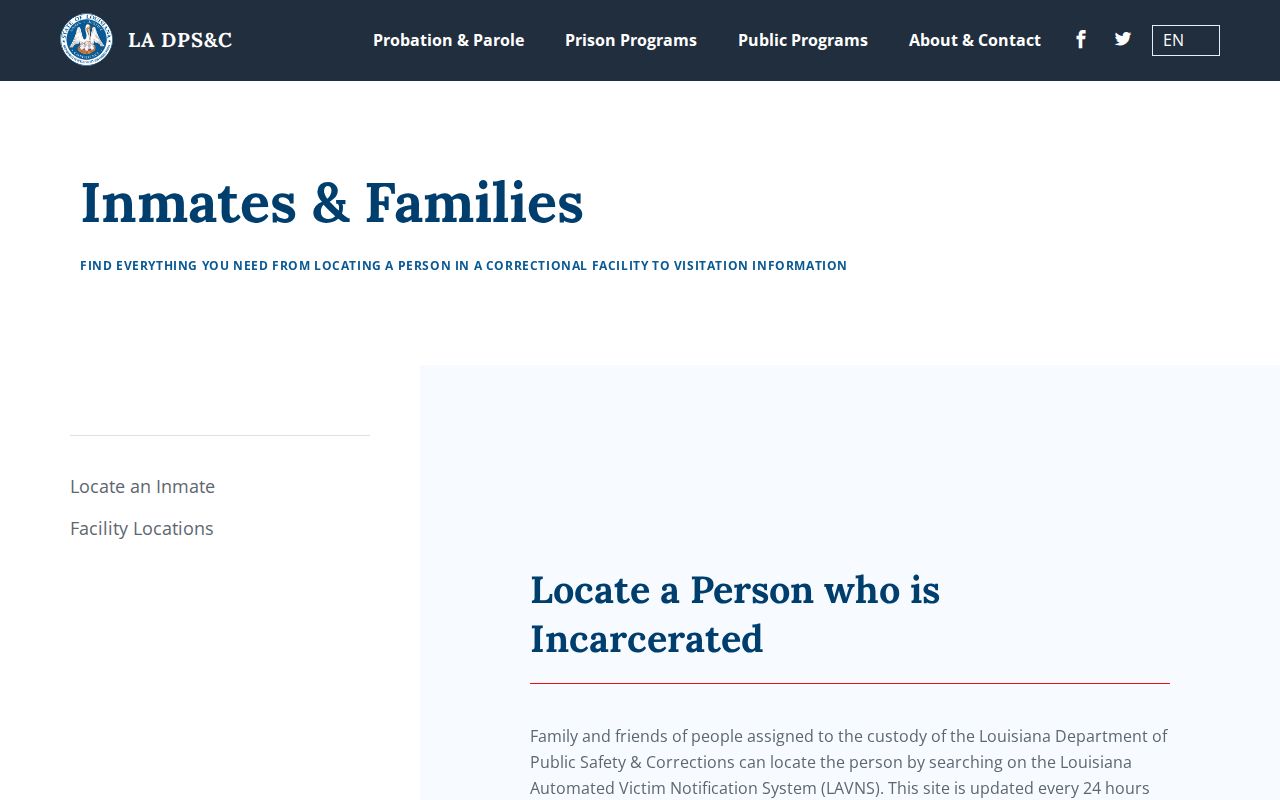
The captured agency page identifies the state source, while the live person result supplies the current label and date for a specific computation.
Union Parish Good-Time Release Rules
For an offense committed on or after August 1, 2024, R.S. 15:571.3.1 generally allows an eligible felony offender in a parish prison or DPS&C custody to earn ordinary diminution up to 15% of the imposed sentence. Diminution means a lawful reduction based on earned credit. The ordinary provision excludes listed sex-offense convictions and habitual-offender sentences. It also bars ordinary good time on presentence credit awarded under Code of Criminal Procedure article 880.
That cap creates the rough “85%” phrase. If ordinary diminution alone cannot exceed 15%, it generally cannot reduce an otherwise eligible imposed term below about 85%. It is not a promised release date. Additional qualifying program credits, forfeitures, split sentences, presentence credit, concurrent or consecutive terms, and offense-specific laws can change the result.
Earlier offenses fall under the more complex framework in R.S. 15:571.3. Its treatment varies by date, offense, sentence, and status. The newer formula cannot be applied backward. DPS&C has sole computation authority, so no public lookup should attempt to recalculate a person’s date from an offense label alone.
Note: Good time reduces an eligible computation; it does not erase a detainer, new sentence, or court order that still blocks release.
Why Union Parish Release Dates Change
A forecast can move whenever the legal inputs or posted credits change. Some updates correct old data. Others reflect new events. Ask for the reason from the authority that performs the computation rather than guessing from a later date displayed online.
| Factor | Possible effect | Best source |
|---|---|---|
| Sentencing documents | A late, amended, or corrected judgment changes the calculation | Sentencing court and DPS&C records |
| Custody credit | A correction changes time credited before or after sentencing | Court judgment and computation authority |
| Earned credit | Program credit may post after work or program requirements are met | DPS&C or facility records office |
| Forfeiture or restoration | Discipline can remove credit, while a lawful restoration can add it back | Facility and DPS&C computation record |
| New sentence | A consecutive term can extend the projected date | Court and DPS&C |
| Detainer or hold | Another agency may take custody instead of community release | Holding and receiving agencies |
| Parole action | A decision may alter the route to conditional community release | Committee on Parole and DPS&C |
A detainer is a request or hold from another authority. It can prevent community release even when one sentence date arrives. Departure from UPDC may then mean transfer to another parish, DPS&C, federal, or immigration custody. Each event needs its own record.
Confirm Union Parish Actual Release Dates
Check the public status again after the projected date. For a state prisoner, compare DPS&C status, a LAVINE event, the assigned Probation and Parole office, and the institutional release entry. For a local Union Parish detainee, call UPDC and request the existing release or transfer record from the proper custodian. Court minutes can show what the judge ordered but may not state the exact time a person left.
The Union Parish VINELink Release Check explains how to register on the exact person record. An automated notice can arrive before a public refresh or after the physical event. Preserve the notice, then request the underlying record. A notification is not a certified release document.
If the person is transferred to state custody, the local app may stop displaying the person while DPS&C begins showing a new location. That is continued custody. If the state result later shows parole or community supervision, prison custody ended but the sentence continues under conditions. Full discharge is a separate status.
Union Parish Offense-Date Calculation Shift
Offense date sharply changes the Louisiana calculation. The post-August 1, 2024 ordinary diminution cap applies only within its statute and eligibility rules. It does not convert every sentence into a simple 85% term. A person excluded by offense type or habitual-offender status needs the law that governs that judgment, while an older offense remains under the earlier scheme.
Parole is a separate question. For offenses on or after August 1, 2024, R.S. 15:574.22 generally removes parole eligibility except for enumerated categories. Older offenses and special groups use R.S. 15:574.4, which contains several thresholds and exceptions. An “85% parole date” therefore joins two distinct concepts and can be wrong.
The sound method is to use the date DPS&C produces, preserve its exact label, and verify any change. Conceptually, the agency starts with the imposed sentence, applies concurrent or consecutive structure and lawful presentence credit, posts eligible earned credits, adds forfeitures or changes, and accounts for holds. The actual computation stays with DPS&C.
Concurrent terms run at the same time to the extent the judgment provides. Consecutive terms run one after another. Presentence credit reflects qualifying time already spent in custody, but the 2024 ordinary good-time statute does not award ordinary diminution on that credit. These terms affect the forecast in different ways and should be taken from the judgment and agency calculation, not inferred from the total number of charges.
Correct Union Parish Release Computations
For a state-facility prisoner, send a computation concern in writing to the facility Records Office. A state-felony prisoner housed at a local site uses the Administrative Remedy Process. The request should identify the person, sentence, disputed field, and supporting court document without demanding that public staff create a new legal analysis.
The public offender result does not expose the full Master Prison Record. R.S. 15:574.12 treats correctional records as generally confidential while identifying some public information. Ask for releasable date and status fields. A narrow request is more likely to reach the correct record than a demand for an entire internal file.
DPS&C time-computation information is available at 225-342-0799. If the issue is missing sentencing paperwork, also verify the judgment with the Union Parish Clerk and sentencing court. Report both the prior and revised date with labels if the agency corrects the forecast.
For an older former prisoner who no longer appears online, request a narrow release or discharge extract. Include the name, birth information, DPS&C number, and useful date range. Ask for admission, actual release date, release mechanism, releasing facility, and public supervision start or end fields. An empty public result cannot supply those facts.
Union Parish Release Date Terms
Louisiana interfaces and agency material may use more than one date label. Meaning should come from the actual label and agency context, not from a broad synonym.
- Projected release date
- DPS&C’s forecast based on its current sentence computation.
- Tentative release date
- An estimated date that remains subject to change.
- Full-term date
- The end point identified for the sentence term before any distinct legal issue is considered.
- Parole eligibility
- A date or threshold at which parole may be considered, not a grant or release.
- Actual release
- The documented event when a person leaves a facility, whether for the community or another custodian.
Transcribe the wording and check date. When two sources differ, preserve both instead of silently selecting one. A court can act before jail processing, and a public state status can update after the gate event.
Do not drop the source label when saving a date. “Projected,” “eligibility,” “full term,” and “actual” answer different questions. The clearest Union Parish record pairs each date with its agency, status, check time, and the custody event it describes.