
Union Parish Parole Versus Probation
Louisiana separates a parole decision from day-to-day supervision. The Committee on Parole decides parole matters. The Louisiana Department of Public Safety & Corrections Division of Probation and Parole manages people in the community. Parole means a person left prison before the sentence fully expired and must follow set terms. Probation comes from a court judgment and may follow some jail time or no jail time. Neither status means an unconditional discharge.
The distinction matters in Union Parish. A person who bonded out of the Union Parish Detention Center is not on parole merely because the person left custody. Bond keeps the criminal case pending. A state prisoner housed at the detention center or its Transitional Work Program may move into parole supervision through the state system. A probation order, by contrast, appears in the Third Judicial District court record and should be checked against the state supervision assignment.
Release language should stay exact. “Time served” describes satisfaction of a custodial portion as calculated by the authority, but another hold can still prevent departure. “Transfer” means the person left one facility while remaining in custody. Probation, parole, full-term discharge, and bond release each create different records. Using the wrong label can send a Union Parish inquiry to the wrong office and hide the fact that supervision continues.
| Point | Parole | Probation |
|---|---|---|
| Source | Committee on Parole decision after a prison sentence | Court judgment, often with a suspended or deferred custody term |
| Custody meaning | Physical release from prison while the sentence continues | Community sentence that may or may not follow jail time |
| Local proof | DPS&C/LAVINE status, board result, and assigned office | Court order, DPS&C/LAVINE status, and assigned office |
| End point | Official discharge or sentence completion | Court or agency record showing supervision ended |
- Discharge
- The official end of the stated custody or supervision term.
- Absconder
- A supervised person alleged to have left approved supervision without permission.
- Revocation
- A formal action that can end community release and return a person to custody.
- Detainer
- A hold from another authority that may block or change release.
Verify Union Parish Post-Release Supervision
Start with the DPS&C Offender Information instructions. Louisiana routes public online offender information through LAVINE/VINELink and also offers an automated locator. Search by DPS&C number when possible. If using a name, add the date of birth and compare all available identifiers. The state system covers people imprisoned and people under probation, parole, or other community supervision. It is not a historical Union Parish booking archive.
- Classify the event. Determine whether the person bonded from UPDC, completed local time, entered state custody, or received a court probation order.
- Search the exact person in Louisiana offender information. Compare the name, birth date, DPS&C number, location, and status before relying on the match.
- Call the automated locator at 225-383-4580 with the DPS&C number or the person’s name and date of birth. It can identify the assigned Probation and Parole district.
- Contact the district named in the result. Ask for guidance on the status the agency is allowed to confirm, since residence and case assignment can move supervision outside Union Parish.
- Reconcile parole with the official board result or probation with the Union Parish Clerk’s court order. Preserve the date and exact wording of each record.
A public result may lag. “Parole” or “community supervision” supports release from prison, but it does not prove when the person crossed the facility gate. The release entry answers that question. The Union Parish released-inmate search and record path explains how the jail, court, and state records fit together.
Note: A Union Parish arrest does not guarantee Monroe supervision because residence, interstate transfer, and agency assignment can change the district.
Union Parish Monroe Supervision Office
DPS&C expressly assigns Union Parish to the Monroe District Office. The official office page also lists Caldwell, Lincoln, Morehouse, and Ouachita parishes. Use Monroe after the locator identifies community supervision or when seeking the correct district contact. Staff may limit what can be released from a supervision file, so ask for status guidance rather than a complete internal record.
DPS&C Monroe District Office
24 Accent Drive, Suite 101
Monroe, LA 71202
318-362-3171
Monday through Friday, 8:00 a.m. to 4:30 p.m.
Official parole conditions require a parolee to report to Probation and Parole no later than 48 hours after release and submit a monthly report by the fifth day of each month. Those duties help explain why the assigned office can hold more current supervision information than a jail roster. They do not promise that staff will disclose every condition or case detail to any caller.
Prepare a narrow inquiry before calling. Have the full name, date of birth, DPS&C number, and the status or office label shown by the locator. Ask whether Monroe is the correct contact and what public record can confirm the supervision state and date. If staff direct the request elsewhere, record the office name rather than assuming the Union Parish connection is wrong. A person may have an arrest record in Union Parish but live under supervision in another district.
Union Parish Supervision Conditions
Conditions vary by judgment and parole decision. At a high level, supervision can require reporting, an approved residence, compliance with lawful instructions, and prompt notice of changes. A breach may lead to a warning, a warrant, a violation hearing, or revocation. None of those outcomes should be inferred from a stale locator entry. Read the exact status and seek the official action.
Louisiana’s victim-notification network can show custody or status events from participating agencies, yet it is not a certified supervision file. R.S. 15:1229 expressly disclaims guaranteed accuracy, timeliness, and completeness. If a notification suggests return to custody, compare it with the assigned office, the facility record, and any board violation action. A transfer between agencies can appear as departure from one location without ending custody.
Union Parish Absconder Warrant Checks
DPS&C publishes selected cases on its Most Wanted page. It is not a complete list of Union Parish absconders or supervision warrants. A name on that page indicates an unresolved warrant posture and possible return to custody. Absence proves nothing about compliance, discharge, or warrant status.
The Board’s violation policy explains that leaving an approved residence without permission can lead to absconder treatment. Apprehension may return a person to DPS&C custody for revocation proceedings. For a specific case, use the Monroe District assignment and the Board’s violation or warrant line at 225-342-1550. Do not label a person an absconder from rumor or roster absence.
Union Parish Parole Decision Records
The Louisiana Board of Pardons & Committee on Parole holds public hearings by Zoom, streams them on YouTube, and publishes hearing-week notices through its Parole Dockets page. A docket is an agenda, not a final result. The Board says hearings are usually scheduled within nine months of eligibility, while the posted notice supplies the actual meeting date.
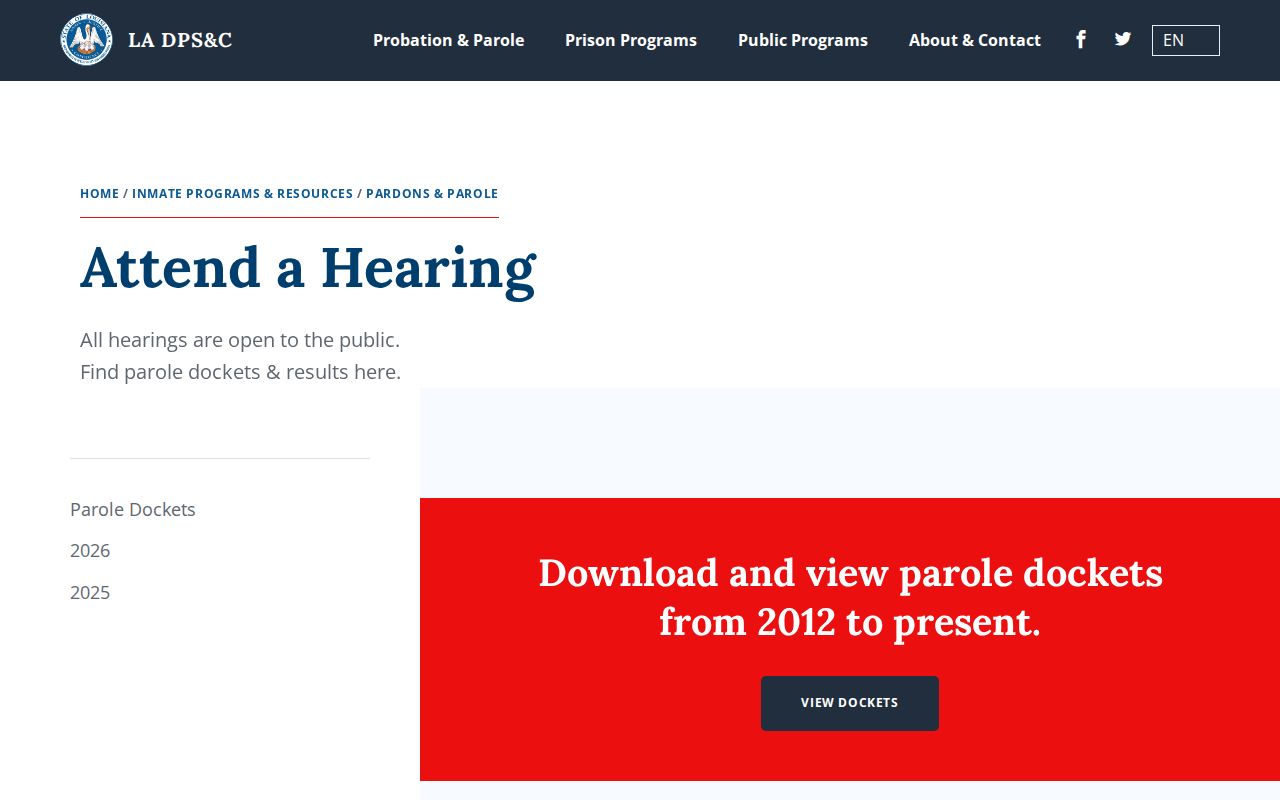
The captured official page shows where hearing dockets and schedules are posted, while the individual result and DPS&C status establish what followed.
Record the exact official outcome. A grant authorizes parole subject to processing and conditions; it is not the physical release timestamp. A denial means parole was not approved at that hearing. Older results from 2012 forward may appear in the Board’s legacy results view. If that older system fails, contact post-hearing processing at 225-342-6550 or the Board at 225-342-6622 and paroleboard@la.gov.
Eligibility turns on offense date and category. For offenses on or after August 1, 2024, R.S. 15:574.22 generally removes parole eligibility except for listed exceptions. R.S. 15:574.4 contains the older and special categories. The record and current statute control, not a broad claim about an “85% parole date.”
Board records and supervision records answer separate questions. The hearing record shows what the Committee decided. DPS&C status shows how the state presently classifies the person. The district office manages the community case. A facility release entry supplies the physical departure time. Reconciling all four prevents a grant from being reported as a completed release before processing and prevents a later revocation from being missed.
Union Parish Supervision Discharge Records
Supervision ends only when the responsible authority records discharge, sentence completion, or another lawful termination. A person who stops appearing in a public result should not be presumed discharged. Public offender information can change, and some fully discharged people may not remain searchable for an indefinite period.
For parole, compare the DPS&C status with the sentence and any official discharge entry. For probation, use the Third Judicial District court record to find the judgment, later minute entries, and any order ending or changing supervision. The Union Parish Clerk can preserve that legal history after a live agency screen changes. A narrow public-records request may seek releasable status and date fields, although R.S. 15:574.12 keeps many correctional records confidential.
Discharge differs from release. Release describes leaving physical custody, often with parole or probation still active. Discharge marks the end of the stated state custody or supervision obligation. A separate case, warrant, or detainer can still affect the person, so match each record to its case and agency.
Note: Keep the search date and exact status label because later DPS&C updates may change what the public record displays.